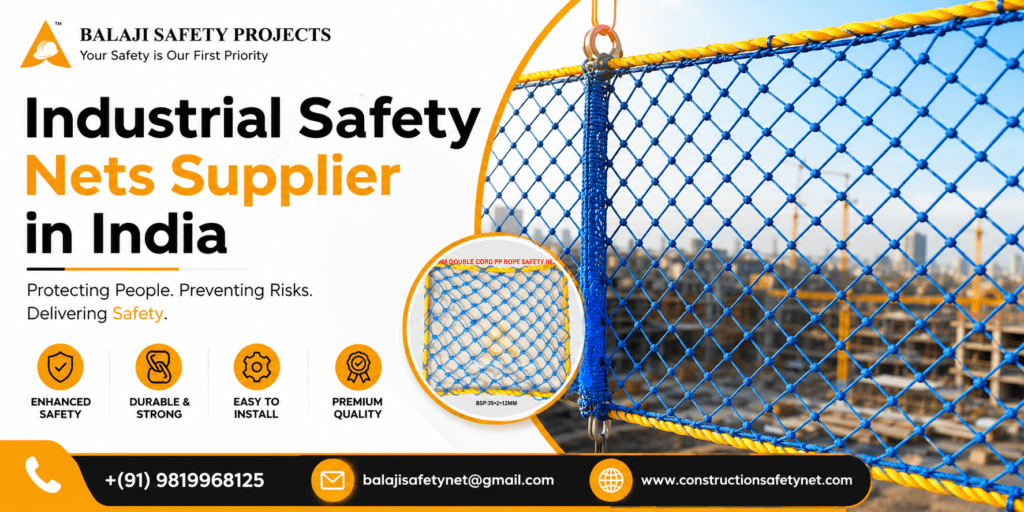
Industrial Safety Nets Supplier in India
Introduction
Balaji Safety Projects provides workplace safety netting solutions for the roofing and construction industries. Additionally, our product range encompasses Braided Safety Nets, Agro Shade Nets, Monofilament Nets / Scaffolding Nets, Anti-Bird Net, Bird Spikes, Full Body Harness & Protective Equipment, and ropes etc. We use good quality raw materials to make these safety nets and ropes. Since the establishment of the company, we have regularly improved our existing range of products of safety nets in order to come up with products that stand high in performance and durability.
Safety is one of the most important requirements at construction sites, industrial plants, warehouses, factories, and commercial buildings. Working at height involves many risks, and even a small mistake can lead to serious accidents. This is why proper safety equipment is essential for protecting workers, materials, and property. Industrial safety is one of the most important parts of any construction, manufacturing, warehouse, infrastructure, and industrial project. Workers often work at height, near open spaces, machinery, platforms, roofs, shafts, and other areas where accidents can happen. A properly installed safety net can help reduce the risk of serious injuries and create a safer working environment.
Balaji Safety Projects is a trusted Industrial Safety Nets Supplier in India, providing reliable safety net solutions for different industrial and construction requirements. The company focuses on supplying strong, durable, and practical safety nets designed to improve workplace safety and reduce the risk of falls and accidents. As a trusted Industrial Safety Nets Supplier in India, Balaji Safety Projects provides quality safety net solutions designed for different industrial and construction requirements. With a focus on product quality, durability, and practical safety, the company helps businesses improve protection at their workplaces. We are the best Industrial Safety Nets Manufacturer.
What Are Industrial Safety Nets
Industrial safety nets are protective nets installed in areas where there is a risk of falling people, tools, equipment, or materials. They are commonly used around construction buildings, factory structures, scaffolding, shafts, balconies, and other elevated working areas. These nets are generally manufactured using strong synthetic materials that can provide good resistance to tension, weather conditions, and regular industrial use. Depending on the application, different types and sizes of safety nets can be selected.
A properly installed safety net acts as an additional protective layer and helps create a safer working environment. These nets are manufactured using strong and durable materials that can withstand regular industrial use. Depending on the application, safety nets can be installed horizontally or vertically to provide an additional layer of protection. A properly selected safety net can provide an additional layer of protection where conventional safety equipment may not be sufficient. We are the best Industrial Safety Nets Provider.
Why Choose Balaji Safety Projects
1. Strong and Durable Construction
- Industrial environments can expose safety nets to impact, abrasion, sunlight, moisture, dust, and changing weather conditions. A dependable supplier provides nets manufactured for the required working conditions, helping improve service life and reliability. High-strength construction is particularly important for fall-arrest applications because the net must be capable of absorbing impact safely. The selection of mesh, twine, border rope, dimensions, and overall construction should therefore be based on the intended application rather than simply choosing the lowest-cost option.
2. Compliance with Indian Safety Requirements
- A professional Industrial Safety Nets Supplier in India understands the importance of applicable standards and documentation. IS 11057 specifies requirements for industrial safety nets and includes provisions related to construction, testing, materials, and performance. When purchasing safety nets for a major construction or industrial project, buyers should ask the supplier for appropriate product specifications, test documentation, and certification information applicable to the project.
3. Protection Against Falls and Falling Debris
- Safety nets can provide collective protection in areas where workers are operating at height. They can also help prevent tools, materials, and debris from falling into areas below. Modern safety-net solutions are available for different purposes, including personnel fall arrest, debris arrest, or combined fall and debris protection. The Indian standard specifically identifies several of these applications for industrial safety nets.
4. Customised Sizes and Specifications
- Every construction or industrial site has different dimensions and installation requirements. Standard-size netting may not always provide the required coverage. An experienced supplier can provide safety nets according to project requirements, including customised dimensions, mesh sizes, net configurations, and suitable materials. Manufacturers in India commonly offer safety net dimensions and mesh sizes according to application requirements. Customised supply can help contractors achieve better coverage while reducing unnecessary material wastage.
5. UV and Weather Resistance
- Safety nets used outdoors are continuously exposed to sunlight and weather conditions. UV stabilisation can help improve durability during prolonged outdoor use. Industrial safety net manufacturers offer UV-stabilized solutions designed for construction and infrastructure environments. This feature is especially valuable for projects where the net remains installed for extended periods.
6. Suitable for Heavy-Duty Industrial Applications
- Industrial safety nets are not limited to conventional building construction. They can be used across infrastructure, manufacturing, maintenance, and other industrial applications. For example, safety-net systems can be used around construction structures to provide fall protection and debris containment, while specialised industrial netting can support material-handling and other workplace safety applications. A knowledgeable supplier can recommend the appropriate net construction according to the working environment and the type of hazard being controlled.
7. Easy Installation and Maintenance
- A good industrial safety net should not only provide protection but also be practical to install, inspect, maintain, relocate, and replace when required. The supplier should provide clear recommendations regarding installation, fixing points, supporting arrangements, inspection, and maintenance. Proper installation is essential because even a high-quality net may not provide the intended protection if it is incorrectly positioned or secured.
8. Reliable Quality Control
- Safety equipment requires consistent manufacturing quality. A professional supplier should have suitable quality-control procedures covering raw materials, net construction, dimensions, strength, and finished-product inspection. Relevant documentation can also help procurement teams verify whether the supplied product meets the required project specifications. Includes provisions concerning certification information and testing of safety nets.
9. Cost-Effective Safety Solution
- Selecting a quality supplier is not simply about finding the cheapest safety net. The total value depends on durability, performance, application suitability, installation requirements, maintenance, and expected service life. A properly selected safety net can help reduce the risk of accidents, protect materials and people below elevated work areas, and support better site safety management.
10. Better Quality Control
- A reputable supplier understands that safety-net quality must be consistent from one batch to another. Quality control may include checking material, mesh construction, dimensions, rope strength, workmanship, and relevant performance requirements. The Indian standard also provides for manufacturer documentation relating to the type of net, construction, materials, breaking strengths, and test performance.
11. Professional Installation Assistance
- The performance of a safety net depends not only on the quality of the net itself but also on correct installation, anchoring, fixing, positioning, and inspection. Experienced suppliers can assist with site-specific installation requirements and recommend suitable configurations. Professional installation is particularly important for high-rise construction, scaffolding, infrastructure projects, and industrial maintenance areas.

Applications of Industrial Safety Nets
1. Construction Site Safety
- One of the most important applications of industrial safety nets is in the construction industry. High-rise buildings, residential towers, commercial complexes, and industrial structures involve considerable work at height. Workers may be exposed to open floors, edges, shafts, scaffolding, and elevated platforms. Safety nets can be installed around suitable work areas to reduce the consequences of accidental falls and to help contain falling materials. Construction safety nets are also used around building facades and scaffolding to provide additional protection for workers and people below.
2. Fall Protection at Heights
- Working at height is one of the major applications of personnel safety nets. Industrial safety nets can be positioned below elevated working areas to help arrest a worker in the event of an accidental fall. The correct net type, installation method, clearance, and supporting arrangement should always be selected according to the specific site conditions and applicable safety requirements.
3. Scaffolding Safety
- Scaffolding is widely used during building construction, painting, plastering, repair, and maintenance activities. However, workers and materials operating around scaffolding can create risks for people working or moving below. Scaffolding safety nets can be installed around suitable scaffolding structures to provide an additional protective layer. They can help contain small tools, loose materials, and debris while also improving overall site protection. Safety net suppliers commonly provide different mesh sizes and configurations according to project requirements.
4. Debris Protection
- During construction, renovation, demolition, and maintenance, small pieces of concrete, dust, packaging materials, tools, and other objects can accidentally fall from elevated locations. Debris safety nets are designed to help contain such falling materials and reduce the possibility of them reaching workers, pedestrians, equipment, or surrounding areas. This makes them particularly useful for high-rise construction projects and busy urban work zones.
5. Factory and Manufacturing Plant Safety
- Industrial safety nets are also used inside and around manufacturing plants. Factories may have elevated platforms, production areas, conveyors, storage systems, machinery, and maintenance zones where additional protective barriers are required. Safety nets can be customised for specific industrial locations to help separate working areas, protect employees from falling objects, or provide protection around elevated sections of a plant. They can be particularly useful where conventional rigid barriers are difficult to install.
6. Warehouse Safety
- Warehouses often use tall storage racks and shelving systems to maximise available space. Products, cartons, tools, and other materials stored at height can present a falling-object risk. Safety netting can be installed behind or around suitable rack systems to help prevent stored materials from accidentally falling into working or walking areas. Industrial safety nets are also used in warehouse protection applications where goods or equipment may fall from elevated shelves.
7. Bridge and Infrastructure Projects
- Bridge construction, flyovers, highways, expressways, railway infrastructure, and other elevated infrastructure projects require careful safety planning because work is frequently performed above ground level or near public areas. Industrial safety nets can be used for personnel fall protection and debris containment in appropriate locations. The Indian standard for industrial safety nets specifically includes applications such as flyovers, roads, expressways, and other infrastructure work.
8. Building Maintenance and Renovation
- Safety nets are not limited to new construction. They are also useful during building maintenance, repair, painting, cleaning, facade work, waterproofing, and renovation. When workers need to operate near open edges or elevated sections, suitable safety netting can provide an additional protective measure. This is particularly valuable for commercial buildings, residential towers, factories, hotels, and other large structures.
9. Industrial Equipment Installation
- Large industrial equipment often requires installation and maintenance at considerable heights. Conveyors, structural frames, machinery, ducts, pipelines, and other equipment may be installed above production floors. Industrial safety nets can be incorporated into the safety arrangement around suitable elevated work zones. Specifically identifies industrial equipment installation, including conveyor-related work, among applications for industrial safety nets.
10. Shipbuilding and Structural Work
- Shipyards and structural fabrication facilities involve work on large structures where employees may operate at elevated positions. Safety nets can be used in appropriate areas to reduce fall-related risks and help contain falling objects. The Indian standard for industrial safety nets also recognises structural work associated with shipbuilding as an application.
11. Staircase and Open-Shaft Protection
- Construction sites and industrial buildings can have temporary staircases, service shafts, lift openings, and other open sections. These areas can create fall hazards if they are not properly protected. Suitable safety netting can be installed around selected openings and access areas as part of a broader site safety system. Some industrial safety net suppliers specifically provide nets for staircase and facade safety applications.
Specification Table of Industrial Safety Nets
| Specification | Details |
|---|---|
| Material | Industrial Safety Nets |
| Product Name | High-Density Polyethene (HDPE) / Nylon |
| Net Type | Knotted / Knotless |
| Mesh Size | 25 mm – 100 mm or as required |
| Rope Diameter | 4 mm – 12 mm |
| Color | Green, Blue, Black, Yellow or Custom |
| UV Resistance | Yes |
| Weather Resistance | Excellent |
| Tensile Strength | As per application and customized requirement |
| Installation | Easy to install with suitable hooks, ropes or clamps |
| Applications | Construction Sites, Industrial Buildings, Warehouses, Factories, Platforms, Scaffolding and Work Areas |
| Customization | Available in different sizes, mesh sizes and dimensions |
| Service Life | Long-lasting with proper installation and maintenance |
| Safety Function | Helps prevent falls of workers, tools and materials |
Types of Industrial Safety Nets
1. Construction Safety Nets
- Construction safety nets are commonly installed around buildings, scaffolding, platforms, and other elevated working areas. They help protect workers from accidental falls and can also reduce the possibility of construction materials falling onto people below. They are suitable for residential buildings, commercial complexes, high-rise construction, and infrastructure projects.
2. Debris Safety Nets
- Debris safety nets are designed to contain loose materials, tools, dust, and construction debris. They are particularly useful on construction sites where work is carried out at considerable heights. These nets help create a safer working environment for workers as well as people moving around the site.
3. Fall Protection Safety Nets
- Fall protection nets are installed below elevated work areas to reduce the consequences of an accidental fall. They are commonly used for construction workers, maintenance teams, and industrial personnel working at height. Their design and installation should be selected according to the working environment and applicable safety requirements.
4. Building Safety Nets
- Building safety nets are used around the exterior of buildings during construction, repair, painting, and maintenance activities. They provide an additional layer of protection and can also help control falling materials. These nets are especially useful for high-rise and multi-storey construction projects.
5. Industrial Machine Safety Nets
- Industrial facilities may use safety nets around machinery, production areas, platforms, and elevated work zones. These nets can help separate hazardous areas and provide additional protection where conventional barriers may not be practical.
6. Sports Safety Nets
- Sports safety nets are used in cricket practice areas, football grounds, golf facilities, badminton courts, and other sports environments. They help prevent balls and equipment from entering unwanted areas. Depending on the sport, the required mesh size and net strength can vary.
Conclusion
Industrial safety nets are an important safety solution for workplaces where people work at height or where there is a possibility of falling objects. From construction sites and factories to warehouses and infrastructure projects, the right safety net can provide an additional layer of protection and help create a safer working environment. We are the best Industrial Safety Nets Provider in Mumbai.
If you are looking for a reliable Industrial Safety Nets Supplier in India, Balaji Safety Projects can provide practical safety net solutions for a wide range of applications. With a focus on quality, durability, and application-specific requirements, Balaji Safety Projects can be a suitable partner for businesses seeking dependable industrial safety products.