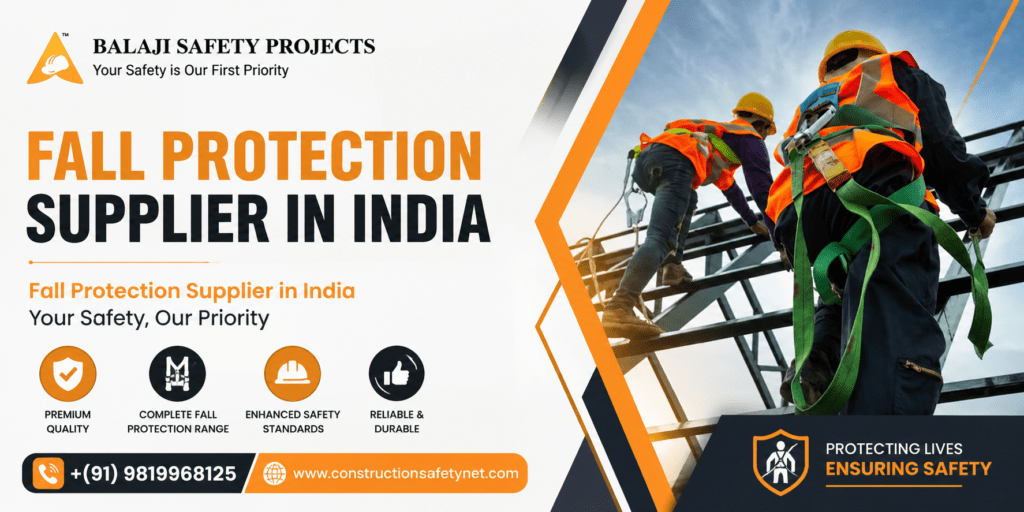
Fall Protection Supplier in India
Introduction
Balaji Safety Projects provides workplace safety netting solutions for the roofing and construction industries. Additionally, our product range encompasses Braided Safety Nets, Agro Shade Nets, Monofilament Nets / Scaffolding Nets, Anti-Bird Net, Bird Spikes, Full Body Harness & Protective Equipment, and ropes, etc. We use good quality raw materials to make these safety nets and ropes. Since the establishment of the company, we have regularly improved our existing range of safety net products in order to come up with products that stand high in performance and durability.
Working at height is common in many industries such as construction, manufacturing, infrastructure, warehouses, oil and gas, maintenance, and telecommunications. However, working at height also comes with serious safety risks. A small mistake or lack of proper safety equipment can result in severe injuries or even loss of life. This is why reliable fall protection equipment is essential for workers who perform tasks at elevated locations. We are the best Fall Protection Manufacturer.
Balaji Safety Projects is a trusted Fall Protection Supplier in India, offering safety solutions designed to help protect workers from fall-related hazards. With a focus on quality, reliability, and worker safety, the company provides fall protection products suitable for different industrial and commercial applications. A trusted Fall Protection Supplier in India can help industries choose the right equipment according to their working conditions and safety requirements. Balaji Safety Projects provides dependable fall protection solutions designed to improve worker safety and support safer working environments.
What Is Fall Protection
Fall protection refers to safety systems, equipment, and procedures used to prevent workers from falling or to reduce the risk of injury if a fall occurs. These systems are commonly required when employees work on roofs, scaffolding, platforms, towers, ladders, construction sites, and other elevated areas.
A complete fall protection system may include safety harnesses, lifelines, anchorage systems, lanyards, retractable fall arresters, and other safety accessories. Selecting the correct equipment is important because every working environment has different safety requirements. As an experienced Fall Protection Supplier in India, Balaji Safety Projects helps industries choose suitable products for their specific working conditions. We are the best Fall Protection Provider in Mumbai.
Importance of Fall Protection Equipment
Falls from height are among the major workplace hazards in industries involving elevated work. Proper fall protection equipment provides workers with an additional layer of safety and helps companies maintain safer working environments.
- Roofs and elevated platforms
- Construction structures
- Industrial plants
- Towers and poles
- Warehouses
- Maintenance platforms
- Bridges and infrastructure projects
Investing in reliable safety equipment is not only about meeting safety requirements. It is also about protecting valuable employees and creating a responsible workplace. Using the correct fall protection equipment can significantly improve workplace safety.
Types of Fall Protection
1. Full Body Harness
A full body harness is one of the most important pieces of personal fall protection equipment. It is designed to distribute the forces generated during a fall across suitable parts of the body rather than concentrating them in one area.
- Construction work
- Tower climbing
- Roof maintenance
- Industrial maintenance
- Wind turbine servicing
- Confined-space operations
- Infrastructure projects
2. Fall Arrest Systems
A fall arrest system is designed to stop a worker after a fall has started and reduce the effects of the fall. A typical personal fall arrest system combines a suitable harness, connecting device, anchorage and associated components.
- Construction
- Steel structures
- Industrial plants
- Warehouses
- Telecommunications
- Power infrastructure
3. Fall Restraint Systems
Unlike fall arrest systems, fall restraint systems are designed to prevent the worker from reaching a location where a fall could occur.
- Flat rooftops
- Elevated platforms
- Maintenance areas
- Industrial walkways
- Roof inspection
- Solar panel maintenance
4. Work Positioning Systems
Work positioning systems allow workers to remain supported while performing tasks at height, often while keeping both hands available for the job.
- Electricians
- Tower technicians
- Utility workers
- Construction workers
- Maintenance personnel
- Pole-climbing professionals
5. Shock-Absorbing Lanyards
Shock-absorbing or energy-absorbing lanyards are connecting devices used as part of suitable fall protection systems. In the event of a fall, the energy absorber is designed to reduce the forces transmitted to the worker and the system.
- Single-leg lanyards
- Twin-leg lanyards
- Adjustable lanyards
- Restraint lanyards
- Work-positioning lanyards
Applications of Fall Protection
1. Construction Sites
- Construction is one of the major applications of fall protection systems. Workers regularly operate on elevated slabs, scaffolding, roofs, steel structures, ladders, temporary platforms, and unfinished buildings. Fall protection equipment helps workers perform installation, fabrication, maintenance, painting, electrical, and structural activities more safely. Full-body harnesses, shock-absorbing lanyards, temporary lifelines, anchorage connectors, and horizontal lifeline systems can be used according to the site requirements. Proper fall protection planning is especially important where workers are exposed to open edges, floor openings, fragile surfaces, or elevated platforms.
2. Rooftop Maintenance
- Rooftop work involves significant risks because workers may be exposed to roof edges, skylights, fragile roofing materials, and sloped surfaces. Fall protection systems are widely used for activities such as HVAC maintenance, solar panel installation, roof inspection, cleaning, waterproofing, painting, and repair work. Permanent or temporary horizontal lifeline systems, roof anchors, lifeline cables, harnesses, and self-retracting lifelines can provide workers with safer access and movement across roof areas.
3. Telecom Towers
- Telecommunication towers require technicians to climb vertical structures for installation, inspection, maintenance, antenna replacement, cable work, and equipment servicing. These activities require reliable vertical fall protection because workers may operate several metres above ground. Vertical lifeline systems, full-body harnesses, energy-absorbing lanyards, rope grabs, tower climbing systems, and suitable anchorage equipment can be used to provide continuous protection while ascending and descending towers. Energy and utility applications similarly use vertical fall arrest solutions for tower and elevated access work.
4. Oil & Gas Industry
- Oil refineries, offshore platforms, drilling facilities, storage terminals, pipelines, and petrochemical plants often involve work at elevated locations. Maintenance personnel may need to access platforms, ladders, tanks, vessels, pipe racks, and other structures. Fall protection solutions can include full-body harnesses, self-retracting lifelines, anchorage systems, horizontal lifelines, vertical lifelines, rescue devices, and engineered access systems. Equipment must be selected according to the working environment and the specific hazards present at the site.
5. Wind Energy Projects
- Wind turbine maintenance requires technicians to work at considerable heights while inspecting blades, nacelles, towers, electrical systems, and mechanical components. Fall protection is therefore an important part of wind energy safety procedures. Vertical lifelines, tower climbing systems, harnesses, self-retracting devices, anchorage systems, and rescue equipment can help protect technicians during installation and maintenance activities. Fall protection providers specifically identify wind turbines as an application requiring fall arrest, lifelines, anchors, rescue, and descent equipment.
6. Power Plants and Electrical Utilities
- Power generation and electrical utility facilities often contain elevated platforms, towers, substations, cable structures, transmission equipment, and maintenance areas. Workers may need to access these locations for inspection, repair, installation, and servicing. Fall protection systems can help provide controlled access and reduce exposure to fall hazards. Depending on the application, workers may use harnesses, lifelines, anchorage connectors, self-retracting devices, and engineered fall protection systems.
7. Manufacturing Industries
- Industrial manufacturing plants frequently have elevated machinery, production platforms, overhead structures, cranes, ducts, tanks, and maintenance areas. Workers may need to climb ladders or platforms to inspect and repair machinery. Fall protection equipment can be used during machine maintenance, plant inspection, equipment installation, painting, fabrication, and other elevated tasks. Overhead cranes and industrial equipment are examples where workers may encounter vertical ladders, moving machinery, electrical equipment, and unguarded edges.
8. Warehouses and Distribution Centres
- Large warehouses often contain high storage racks, loading areas, mezzanine floors, elevated platforms, conveyors, and maintenance equipment. Workers may be required to access elevated areas for stock management, equipment inspection, lighting maintenance, conveyor servicing, or building maintenance. Fall protection solutions such as guardrail systems, lifelines, roof anchors, harnesses, and suitable anchorage systems can be selected according to the workplace design and activity. Transportation and distribution facilities are also recognized applications for work-at-height safety solutions.
9. Overhead Crane Maintenance
- Overhead cranes and crane bays require regular inspection, servicing, and repair. Maintenance personnel may need to access elevated crane structures, rails, ladders, platforms, and machinery. Because workers can be exposed to open edges and moving equipment, engineered lifeline systems, overhead anchor systems, harnesses, and self-retracting lifelines can be incorporated into the safety arrangement. Specialized fall protection solutions are available for overhead crane and gantry applications.
10. Confined Space Entry
- Some confined spaces require workers to enter tanks, vessels, shafts, pits, silos, manholes, and other restricted areas. These locations can create both fall and rescue challenges. Fall protection systems for confined spaces may include tripods, davit systems, winches, retrieval systems, harnesses, lifelines, and rescue equipment. The system should allow safe entry, controlled movement, and emergency retrieval where required.
How to Choose a Fall Protection Supplier in India
Choosing the right Fall Protection Supplier in India is important because worker safety depends heavily on the quality and suitability of the equipment.
- Product Quality: Safety equipment should be manufactured using suitable materials and designed for the intended application.
- Product Range: A supplier offering different fall protection products can make it easier to develop a complete safety system.
- Application Knowledge: The supplier should understand different industrial working-at-height requirements.
- Reliable Support: Technical guidance and product support can help companies select and use equipment correctly.
- Compliance and Standards: Products should be selected according to applicable safety standards and workplace requirements.
Why Choose Balaji Safety Projects
1. High-Quality Fall Protection Equipment
- A professional supplier focuses on providing reliable and durable fall protection equipment designed for demanding working environments. Workers may use safety equipment for extended periods and under challenging conditions, so product quality is extremely important. A trusted Fall Protection Supplier in India can provide equipment manufactured using appropriate materials and quality-control processes. Products such as harnesses, lanyards, hooks, connectors, lifelines, and fall arrest devices should be selected according to the application and expected working conditions.
2. Certified and Standards-Compliant Products
- Safety equipment must be selected carefully because the performance of fall protection equipment can directly affect worker safety. Reputable suppliers provide products designed and tested according to applicable safety standards and certifications. For example, established manufacturers in India offer fall protection products certified to standards such as EN and ANSI, depending on the product and application. Working with a supplier that understands certification requirements helps companies make better purchasing decisions and maintain their workplace safety programs.
3. Solutions for Different Industries
- Every industry has different work-at-height hazards. A construction site may require protection around building edges, scaffolding and rooftops, while a telecom company may need specialised equipment for tower climbing. Similarly, oil and gas, power generation, manufacturing, warehousing, infrastructure, mining, and maintenance operations may require different combinations of personal and engineered fall protection systems. MSA, for example, highlights applications across construction, mining, oil and gas, utilities, aerospace, and general industry.
4. Customised Fall Protection Systems
- Some workplaces cannot be protected effectively with standard equipment alone. Large industrial plants, rooftops, warehouses, towers, and specialised structures may require customised solutions. Experienced suppliers can support systems such as horizontal lifelines, vertical lifelines, roof safety systems, engineered anchorages, access systems, and customised fall protection arrangements. Engineered solutions can be designed around the specific structure and working requirements. Industry suppliers also offer customised and adaptable systems for permanent and temporary applications.
5. Comfortable and User-Friendly Equipment
- Safety equipment that is uncomfortable or difficult to use may discourage workers from using it correctly. Therefore, comfort and usability are important considerations when selecting fall protection equipment. Modern harnesses and fall protection systems are designed with features intended to improve fit, movement, adjustment, and user comfort. MSA, for instance, emphasises the combination of comfort, strength, and safety in its full-body harness range.
6. Reliable Bulk Supply
- Large construction projects, factories, infrastructure companies, and industrial organisations may require safety equipment in bulk. A dependable Fall Protection Supplier in India should be capable of handling larger requirements while maintaining consistent product quality. Reliable supply helps companies avoid delays in safety-related procurement and ensures that workers can receive the required equipment before starting work at height.
7. Inspection and Maintenance Support
- Fall protection equipment should not simply be purchased and forgotten. Regular inspection, proper storage, cleaning, maintenance, and replacement are important parts of an effective safety program. A professional supplier can provide guidance regarding equipment inspection and maintenance procedures. Some suppliers also offer inspection, revalidation, demonstrations, and related support services. This ongoing support can help companies maintain their safety equipment in appropriate working condition.
8. Cost-Effective Safety Solutions
- Choosing the cheapest safety equipment is not always the most economical decision. Low-quality or unsuitable equipment can result in frequent replacement, poor usability, operational problems, or increased safety risks. An experienced supplier can help businesses select equipment based on application, durability, performance, and total operational requirements. This approach can provide better long-term value while maintaining appropriate safety standards.
9. Strong After-Sales Support
- Fall protection is an ongoing requirement. Businesses may need replacement components, additional equipment, inspections, technical assistance, or guidance as their operations expand. A supplier with strong after-sales support can become a long-term safety partner rather than simply a product vendor. This is particularly valuable for companies operating multiple sites or large workforces.
10. Faster and More Reliable Delivery
- Industrial projects often operate according to strict schedules. Delays in receiving safety equipment can affect workforce deployment and project timelines. Established Indian suppliers with dependable distribution networks can support faster delivery and bulk requirements across different regions. This makes local sourcing particularly useful for businesses that need regular supplies or urgent replacement equipment.
11. Better Overall Safety Planning
- The best Fall Protection Supplier in India does not focus only on selling harnesses and lanyards. They understand that effective fall protection involves identifying hazards, selecting suitable equipment, considering anchorage and fall clearance, training workers, inspecting equipment, and preparing for rescue. A comprehensive approach can help organisations build a stronger work-at-height safety program.
Benefits of Fall Protection
1. Improved Worker Safety
- The primary benefit of fall protection equipment is improving worker safety while performing jobs at height. A properly selected full-body harness helps support the worker and distributes fall-arrest forces across stronger areas of the body, including the shoulders, thighs, chest, and pelvis.
2. Reduced Risk of Serious Injuries
- Falls from height can result in severe injuries. Fall arrest systems are designed to stop a falling worker and reduce the consequences of a fall when properly selected, installed, inspected, and used. Energy-absorbing lanyards can help reduce the forces transmitted to the worker during a fall-arrest event.
3. Complete Fall Protection Solutions
- A professional supplier can provide more than just safety harnesses. A complete solution may include harnesses, lanyards, connectors, anchorage devices, lifelines, self-retracting lifelines, and rescue equipment. This allows companies to select compatible components for their particular working environment.
4. Suitable for Multiple Industries
- Fall protection equipment can be used across many industries. Construction workers, tower technicians, maintenance teams, telecom workers, warehouse personnel, infrastructure workers, and industrial technicians may all require different types of height-safety equipment depending on their work environment.
5. Better Worker Comfort
- Workers may need to wear safety equipment for several hours. Ergonomically designed harnesses with adjustable shoulder, chest, and thigh straps can provide a more secure and comfortable fit. Better comfort can also encourage workers to use the equipment correctly throughout their working shift.
6. Secure Body Positioning
- Full-body harnesses can help maintain a worker’s body position when connected to an appropriate fall protection system. Different D-ring configurations may support applications such as fall arrest, work positioning, travel restraint, retrieval, or ladder climbing, depending on the harness design.
7. Reliable Anchorage and Connection
- A harness alone does not constitute a complete fall protection system. Proper anchorage and compatible connecting equipment are equally important. A knowledgeable Fall Protection Supplier in India can help customers identify appropriate harnesses, lanyards, connectors, and anchorage solutions according to the application.
8. Helps Minimise Workplace Accidents
- Using appropriate fall protection equipment as part of a properly designed safety program can reduce exposure to fall hazards. Businesses can combine personal fall protection with safer access methods, guardrails, suitable anchorage, worker training, equipment inspections, and rescue planning.
9. Durable Industrial Construction
- Quality fall protection equipment is manufactured using materials designed for demanding industrial environments. High-strength webbing, durable metal components, secure stitching, and robust connectors help equipment withstand regular workplace use when properly maintained and inspected.
10. Better Worker Confidence
- When workers have properly fitted and suitable fall protection equipment, they can approach height-related tasks with greater confidence. A comfortable and secure harness system can help workers focus on their assigned tasks while following established safety procedures.
Conclusion
Working at height requires careful planning and proper safety equipment. From construction and maintenance to telecommunications and industrial operations, fall protection systems can play an important role in protecting workers from dangerous falls.
If you are looking for a dependable Fall Protection Supplier in India, Balaji Safety Projects offers a range of safety solutions for different industrial applications. With a focus on quality, reliability, and customer requirements, the company aims to support businesses in creating safer working environments.