
Connecting Lanyard Supplier in India
Introduction
Balaji Safety Projects provides workplace safety netting solutions for the roofing and construction industries. Additionally, our product range encompasses Braided Safety Nets, Agro Shade Nets, Monofilament Nets / Scaffolding Nets, Anti-Bird Net, Bird Spikes, Full Body Harness & Protective Equipment, and ropes, etc. We use good quality raw materials to make these safety nets and ropes. Since the establishment of the company, we have regularly improved our existing range of safety net products in order to come up with products that stand high in performance and durability.
Workplace safety is one of the most important requirements in industries where employees work at height. Construction sites, factories, warehouses, infrastructure projects, maintenance work, and other industrial areas often require workers to operate in elevated or difficult locations. In such situations, using the right personal protective equipment (PPE) is essential. We are the best Connecting Lanyard Manufacturer.
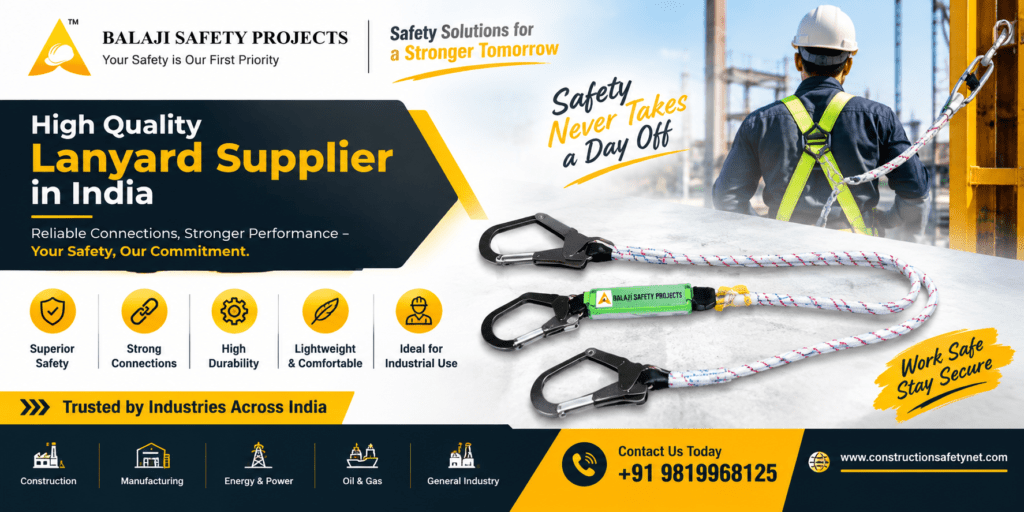
A connecting lanyard is an important part of a height safety system. It helps connect a worker’s harness to a suitable anchorage point or safety system. Choosing a reliable Connecting Lanyard Supplier in India is therefore important for companies that want dependable and suitable safety equipment for their workers. Balaji Safety Projects provides safety solutions designed to support professionals working in challenging industrial environments. With a focus on quality, reliability, and customer requirements, the company serves businesses looking for dependable height safety products and solutions.
What Is a Connecting Lanyard
A connecting lanyard is a safety component used with a full-body harness and an appropriate anchorage system. It generally consists of a strong connecting element along with suitable hooks, connectors, or other compatible components. We are the best Connecting Lanyard Provider.
Depending on the application, lanyards may be designed for different purposes, such as work positioning, restraint, or fall protection systems. The selection of the lanyard should always match the application, compatible equipment, and manufacturer’s instructions. A properly selected lanyard can help workers remain connected to an appropriate safety system while performing their tasks at height.
Why Choose Balaji Safety Projects
1. High-Quality Connecting Lanyards
- A professional Connecting Lanyard Supplier in India focuses on manufacturing and supplying high-quality products. Good-quality lanyards are manufactured using suitable raw materials and carefully controlled production processes. This helps provide better strength, flexibility, durability, and resistance to regular wear and tear. High-quality connecting lanyards can perform reliably even when they are used frequently in demanding industrial environments. Choosing a trusted supplier helps businesses reduce the risk of premature product failure.
2. Strong and Durable Materials
- The material used for manufacturing a connecting lanyard directly affects its performance. Depending on the application, suppliers may offer products manufactured using suitable metals, polymers, cables, webbing, or other engineering materials. A professional supplier understands that different applications require different material properties. Factors such as strength, flexibility, corrosion resistance, operating environment, and expected service life can be considered while selecting the appropriate product.
3. Customised Solutions
- One of the major benefits of working with an established Connecting Lanyard Supplier in India is the availability of customised solutions. Standard products may not always meet the exact requirements of a particular machine, assembly, or industrial application. A reliable supplier can understand the customer’s technical requirements and provide connecting lanyards according to specific dimensions, materials, lengths, fittings, or other specifications.
4. Consistent Product Quality
- Consistency is very important when purchasing industrial components in bulk. A professional supplier maintains quality standards throughout the manufacturing process to ensure that every batch provides similar performance. Consistent quality helps manufacturers maintain uniformity in their products and reduces problems during assembly and operation. It also makes inventory management easier because buyers can expect similar specifications from repeated orders.
5. Durable and Reliable Products
- Connecting lanyards may be exposed to continuous movement, vibration, pulling, tension, or other operating conditions depending on the application. Therefore, durability is an important factor when selecting a supplier. A dependable Connecting Lanyard Supplier in India provides products designed for reliable service and suitable performance. Durable lanyards can help reduce frequent replacements and unnecessary maintenance costs.
6. Competitive Pricing
- India has a well-established manufacturing and supply chain network, allowing suppliers to offer industrial components at competitive prices. Buying directly from an Indian supplier can be cost-effective for domestic manufacturers and industrial users. Competitive pricing does not simply mean choosing the cheapest product. Buyers should consider the complete value, including quality, service life, customisation, delivery, and after-sales support.
7. Bulk Order Availability
- Many industries require connecting lanyards in large quantities for production, assembly, maintenance, or regular replacement. A professional supplier should have the manufacturing and inventory capability to handle bulk requirements. Whether the requirement is for a small quantity or a large production order, choosing an experienced supplier can help ensure a smooth supply process.
8. Fast and Reliable Delivery
- Timely delivery is important for manufacturing companies. Delays in receiving small but essential components can affect production schedules and increase downtime. An established Connecting Lanyard Supplier in India generally has an organised production and dispatch system. This helps suppliers process orders efficiently and deliver products according to agreed timelines.
9. Technical Support
- Industrial buyers often need more than just a product. They may require assistance in selecting the correct size, material, design, or specification. A knowledgeable supplier can understand the application and help customers select an appropriate connecting lanyard. Technical support is especially useful for OEMs and engineering companies working on customised machines or assemblies.
10. Better Quality Control
- Quality control plays an important role in industrial component manufacturing. A reliable supplier checks products at different stages of production to maintain dimensional accuracy, material quality, and overall performance. Quality-focused manufacturing can help identify defects before products reach the customer. This results in better reliability and fewer quality-related issues during installation or operation.
11. Strong Manufacturing Capabilities
- Choosing a manufacturer or experienced supplier rather than an unknown reseller can provide several advantages. A manufacturer has greater control over raw materials, production processes, customisation, inspection, and packaging. For businesses with long-term requirements, working with a capable Connecting Lanyard Supplier in India can create a more dependable procurement relationship.
12. Long-Term Supplier Relationship
- Businesses often need connecting lanyards repeatedly. Changing suppliers for every order can create problems related to quality differences, pricing, delivery schedules, and specifications. Working with a trusted supplier for the long term can provide better consistency and easier communication. Regular customers can also benefit from smoother order processing and better understanding of their standard requirements.
13. Focus on Customer Satisfaction
- A professional supplier understands that customer satisfaction depends on more than product quality. Timely communication, accurate specifications, competitive pricing, proper packaging, and after-sales support all contribute to a positive purchasing experience. This customer-focused approach makes it easier for businesses to build long-term partnerships with their suppliers.
Applications of Connecting Lanyard
1. Construction Industry
- Construction is one of the major applications of connecting lanyards. Workers involved in building construction, structural work, roofing, scaffolding and maintenance may work at considerable heights. A suitable lanyard can help connect a worker’s harness with an approved anchorage or safety system. For construction companies, selecting the correct lanyard according to the work environment, connection type, length and applicable safety requirements is important.
2. Tower and Telecom Work
- Telecommunication towers require technicians to climb structures and perform installation, inspection and maintenance activities. Connecting lanyards can be used as part of an appropriate height-safety system to help maintain a secure connection while working on towers. Specialised tower-climbing configurations may include lanyards with suitable hooks or connectors and energy-absorbing components where required.
3. Industrial Maintenance
- Factories and industrial plants often have elevated platforms, machinery, storage structures and maintenance areas. Workers may need to access these locations for inspection, repair and servicing. A connecting lanyard can be incorporated into the worker’s fall-protection system to provide a connection between the harness and approved anchorage equipment.
4. Roofing Applications
- Roof maintenance and installation can involve significant fall hazards, particularly around roof edges, fragile surfaces and elevated working areas. Connecting lanyards can be used with compatible harnesses and anchorage systems to support safer working practices. The lanyard must be selected according to the specific roof-work application and the manufacturer’s instructions.
5. Work Positioning
- Some connecting lanyards are designed specifically for work-positioning applications. These products allow workers to maintain a controlled working position while keeping their hands available for performing tasks. For example, certain adjustable rope lanyards incorporate a rope adjuster and karabiners for positioning and hands-free work.
6. Scaffolding Work
- Scaffold erection, modification and dismantling can require workers to operate at elevated levels. Connecting lanyards can form part of a suitable fall-protection arrangement when used with compatible harnesses and anchorage points. Scaffolding contractors can therefore source appropriate lanyards from a reliable Connecting Lanyard Supplier in India for regular projects and maintenance operations.
7. Warehouse and Elevated Storage Areas
- Large warehouses, distribution centres and industrial storage facilities may contain elevated racks, platforms and maintenance zones. Workers performing inspection, repair or installation work in these areas may require fall-protection equipment. Connecting lanyards can be selected according to the working height, movement requirements and type of approved anchorage available.
8. Wind Turbine and Energy Projects
- Renewable-energy installations such as wind turbines involve work at considerable heights. Technicians may need to climb, inspect components and perform maintenance inside or around elevated structures. A properly selected fall-protection system, which may include suitable connecting lanyards, helps support safe access and maintenance procedures.
9. Oil, Gas and Petrochemical Plants
- Oil and gas facilities contain elevated structures, pipelines, platforms and maintenance areas. Workers carrying out inspection and maintenance activities may require specialised personal protective equipment. Connecting lanyards can be used as part of a complete height-safety system, provided the equipment is suitable for the particular environment and task.
10. Bridge and Infrastructure Maintenance
- Bridges, flyovers and other infrastructure require regular inspection, repair and maintenance. Workers may need to operate above ground or water, making appropriate fall protection particularly important. Connecting lanyards can be used with compatible harnesses and anchorage systems to help workers remain connected while carrying out maintenance activities.
Specification Table of Connecting Lanyard
| Specification | Typical Details |
|---|---|
| Material | Connecting Lanyard |
| Product Type | Fall Protection / Safety Equipment |
| Product Name | High-Strength Webbing or Rope |
| Length | Available in Different Lengths |
| Connector | Hook / Carabiner / Compatible Connector |
| Configuration | Single or Double Leg, Depending on Model |
| Application | Work at Height and Fall Protection |
| Compatibility | Safety Harness and Suitable Anchorage Systems |
| Stitching | High-Strength Safety Stitching |
| Usage | Construction, Industrial, Maintenance, Towers, etc. |
| Custom Options | Available Depending on Requirement |
| Inspection | Regular Inspection Recommended |
| Packaging | Individual / Bulk Packaging as Required |
Types of Connecting Lanyards
1. Rope Connecting Lanyard
Rope connecting lanyards are manufactured using strong synthetic ropes such as polyamide or polyester. They are widely used in industrial work-at-height applications. These lanyards can be supplied with different combinations of loops, carabiners, snap hooks, or other connectors.
- Construction sites
- Industrial maintenance
- Tower work
- Electrical work
- General work-at-height applications
- Engineering industries
2. Webbing Connecting Lanyard
Webbing lanyards are made from high-strength woven polyester or similar synthetic webbing. They are lightweight, flexible, and easy to handle. Webbing lanyards are available in different lengths and connector combinations. Industrial suppliers commonly provide models with snap hooks, karabiners, scaffold hooks, and energy-absorbing components.
- Lightweight construction
- Easy handling
- Flexible design
- High tensile strength
- Suitable for industrial environments
- Available in different configurations
3. Shock-Absorbing Connecting Lanyard
Shock-absorbing lanyards are designed for applications where fall arrest is required. They incorporate an energy-absorbing element that helps limit the forces transmitted to the worker during a fall.
- Construction
- Steel structures
- Manufacturing plants
- Warehouses
- Maintenance work
- Oil and gas facilities
- Infrastructure projects
4. Single-Leg Connecting Lanyard
This configuration can be suitable when the work area allows the worker to remain connected to one approved anchor point. 3M describes single-leg styles as suitable for connection to a single anchor point within a defined range of movement.
- Simple design
- Easy to use
- Lightweight
- Convenient for fixed-point applications
- Suitable for specific work zones
5. Double-Leg or Twin-Leg Connecting Lanyard
Double-leg lanyards, also called twin-leg or Y-shaped lanyards, have two connection legs. They are particularly useful when workers need to move between anchorage points while maintaining continuous connection.
- Structural steel erection
- Construction
- Tower maintenance
- Industrial maintenance
- Work involving multiple anchor points
Conclusion
A connecting lanyard is an essential component for many work-at-height safety applications. With different options such as single-leg lanyards, double-leg lanyards, shock-absorbing lanyards, adjustable lanyards, rope lanyards, webbing lanyards, cable lanyards, and positioning lanyards, businesses can select equipment according to their specific working requirements.
If you are looking for a reliable Connecting Lanyard Supplier in India, Balaji Safety Projects can be a suitable source for quality safety solutions. With application-focused products and professional support, the company aims to help industries improve their work-at-height safety practices. Choose the right connecting lanyard, follow proper inspection procedures, and always use the equipment as part of a suitable and properly designed fall-protection system.