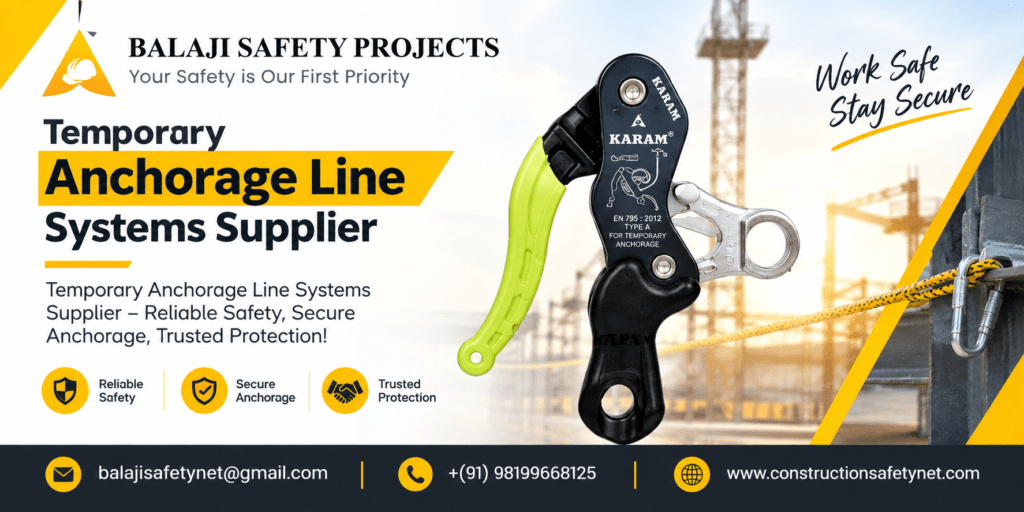
Temporary Anchorage Line Systems Supplier
Introduction
Balaji Safety Projects provides workplace safety netting solutions for the roofing and construction industries. Additionally, our product range encompasses Braided Safety Nets, Agro Shade Nets, Monofilament Nets / Scaffolding Nets, Anti-Bird Net, Bird Spikes, Full Body Harness & Protective Equipment, and ropes, etc. We use good quality raw materials to make these safety nets and ropes. Since the establishment of the company, we have regularly improved our existing range of products of safety nets in order to come up with products that stand out for performance and durability.
Working at height is a common requirement in construction, maintenance, industrial, infrastructure, and installation projects. Workers who operate on roofs, structures, platforms, towers, and other elevated areas need proper safety systems to reduce the risk of falls. A Temporary Anchorage Line System is an important fall protection solution that provides workers with a secure connection point while they perform their tasks at height.
Balaji Safety Projects is a reliable Temporary Anchorage Line Systems Supplier, offering safety-focused solutions for different industrial and construction requirements. Our systems are designed to support safer work-at-height operations and can be selected according to the application, structure, working environment, and project requirements.
What Is a Temporary Anchorage Line System
A Temporary Anchorage Line System is a removable fall protection system that can be installed for a particular project or work activity and removed after the job is completed. It provides workers with a secure attachment point for compatible personal fall protection equipment such as full-body harnesses and connecting devices.
Unlike permanent anchorage systems, temporary systems are useful when the work location changes frequently or when permanent installation is not practical. They can be suitable for construction projects, maintenance work, temporary structures, shutdown activities, and other applications where workers need temporary protection. The system should be selected according to the work environment, structure, number of users, installation requirements, and applicable safety requirements.
Why Is a Temporary Anchorage Line System Important
- Safety should always be a priority when employees are required to work at height. A fall from an elevated surface can result in serious injury or damage. Temporary anchorage systems provide a controlled connection point for fall protection equipment.
- Provides a secure connection for fall protection equipment
- Supports safer movement along designated work areas
- Useful for temporary and changing work locations
- Can reduce the need for permanent structural modifications
- Suitable for construction and maintenance activities
- Helps improve workplace safety practices
- Can be removed when the project is completed
- The system must always be properly selected, installed, inspected, and used according to the manufacturer’s instructions and relevant safety requirements. The exact performance and suitability of a system depend on its design, installation, supporting structure, compatible components, and applicable safety requirements.
Applications of Temporary Anchorage Line Systems
1. Construction Sites
Temporary Anchorage Line Systems are widely used at construction sites where workers need to operate on roofs, elevated platforms, structures, and unfinished buildings. During different stages of construction, permanent safety systems may not yet be available. A temporary anchorage line provides workers with a suitable connection point for fall protection equipment while construction activities are in progress.
2. Industrial Maintenance
Factories and industrial facilities often require maintenance work at elevated locations. Workers may need to inspect machinery, pipelines, storage structures, ducts, roofs, and other installations. Temporary Anchorage Line Systems can provide a practical fall protection arrangement during short-term maintenance and inspection activities.
3. Roof Maintenance and Repair
Roof repair, cleaning, inspection, waterproofing, solar panel installation, and other rooftop activities may expose workers to fall hazards. Temporary anchorage systems can be installed for the duration of the work and removed after the project is completed. They are particularly useful where a permanent lifeline has not been installed.
4. Warehouse and Industrial Shed Work
Large warehouses and industrial sheds often have high roofs, structural beams, skylights, and other elevated areas that require regular inspection and maintenance. Temporary Anchorage Line Systems help create a safer working arrangement for workers carrying out repair, cleaning, electrical, lighting, and maintenance work at height.
5. Solar Panel Installation and Maintenance
Solar installations frequently require workers to access rooftops for panel installation, cleaning, inspection, and maintenance. A temporary anchorage line can be used during project work where a permanent fall protection system is unavailable. It allows workers to connect suitable personal fall protection equipment while working within the designated protected area.
6. Bridge and Infrastructure Projects
Infrastructure projects such as bridges, elevated structures, flyovers, and other civil engineering works may involve workers operating at significant heights. Temporary Anchorage Line Systems can be used during construction, inspection, repair, and maintenance activities to support a controlled fall protection setup.
7. Telecom Tower and Structural Work
Telecommunication and structural installation projects can involve work at elevated locations. During installation, repair, and maintenance operations, suitable temporary anchorage arrangements may be required. These systems can support workers when accessing designated areas where temporary fall protection is appropriate.
8. Building Facade Maintenance
Commercial buildings, industrial structures, and other high-rise facilities require periodic facade inspection, cleaning, repair, painting, and maintenance. Temporary Anchorage Line Systems can be used as part of an appropriate fall protection plan for workers performing these activities at height.
9. Painting and Waterproofing Projects
Industrial painting, building painting, waterproofing, and protective coating work may require workers to operate on elevated surfaces. Temporary anchorage systems can provide connection opportunities for compatible personal protective equipment during short-duration projects.
10. Shutdown and Turnaround Maintenance
Factories, chemical plants, manufacturing units, power facilities, and other industrial sites regularly conduct shutdowns and turnaround maintenance. During these periods, large numbers of maintenance activities may take place in areas that are difficult to access. Temporary Anchorage Line Systems can be deployed for specific work zones as part of the site’s overall fall protection arrangements.
11. HVAC and Mechanical Installation
Installation and maintenance of HVAC equipment, ducts, ventilation systems, and mechanical components may require workers to access elevated locations. Temporary anchorage systems can be useful during installation and servicing work when workers need appropriate fall protection while operating in designated areas.
Types of Temporary Anchorage Line Systems
1. Temporary Horizontal Lifeline Systems
Temporary horizontal lifeline systems are commonly used when workers need to move along a horizontal work area while remaining connected to a fall-protection system. They can be installed between two suitable anchorage points and allow workers to travel along the line. These systems are useful for construction sites, industrial maintenance, roofing, steel structures, and other temporary work-at-height applications. They are designed to provide continuous connection while reducing the need to disconnect and reconnect at multiple points.
2. Temporary Vertical Lifeline Systems
Temporary vertical lifeline systems are used when workers need to climb or descend structures safely. The lifeline is generally installed vertically and can be used with compatible fall-arrest equipment. These systems are suitable for ladders, towers, poles, temporary structures, shafts, and construction areas where permanent fall-protection systems are not available. A professional Temporary Anchorage Line Systems Supplier can provide systems suitable for the required height and application.
3. Rope-Based Temporary Anchorage Lines
Rope-based systems use specially designed ropes and compatible components to create a temporary lifeline or anchorage arrangement. They are often selected for applications where flexibility and relatively quick installation are important. Their lightweight construction can make transportation and handling easier at temporary work locations. The rope, connectors, energy-absorbing components, and anchorage points must be compatible and used according to the manufacturer’s instructions.
4. Temporary Webbing Lifeline Systems
Webbing-based temporary lifelines use high-strength synthetic webbing to provide a flexible connection system. These systems can be useful for short-term construction, maintenance, inspection, and installation work. Webbing systems are generally lightweight and can be packed easily for transportation. They are particularly useful where workers need a temporary fall-protection arrangement that can be installed and removed after the job is completed.
5. Adjustable Temporary Lifeline Systems
Webbing systems are generally lightweight and can be packed easily for transportation. They are particularly useful where workers need a temporary fall-protection arrangement that can be installed and removed after the job is completed. Adjustable systems allow the length of the lifeline to be modified according to the work area. This makes them useful for locations where the distance between anchorage points changes from one application to another.
Why Choose Balaji Safety Projects
1. Focus on Worker Safety
The primary reason to choose a professional Temporary Anchorage Line Systems Supplier is worker safety. A properly selected and installed anchorage system can provide a reliable connection for compatible fall-protection equipment. Professional suppliers understand the importance of using suitable components and following applicable safety requirements.
2. Suitable Solutions for Different Work Areas
Temporary work environments can vary significantly. Construction sites, rooftops, industrial plants, warehouses, towers, and maintenance locations may require different anchorage arrangements. An experienced supplier can offer temporary anchorage solutions suitable for different applications and site conditions.
3. Quality-Focused Products
A reliable supplier focuses on the quality of anchorage lines, connectors, attachment components, and associated safety equipment. Quality materials and proper manufacturing practices help support dependable performance when the system is used correctly within its intended specifications.
4. Easy Installation and Removal
Temporary anchorage systems are generally selected when permanent anchorage infrastructure is not practical or required. A suitable system should be designed for efficient installation, adjustment, and removal according to the manufacturer’s instructions. This can make it convenient for contractors and maintenance teams working at changing locations.
5. Professional Technical Guidance
Selecting the correct anchorage system can require consideration of factors such as the structure, number of users, attachment method, available anchorage points, working area, and fall-clearance requirements. A knowledgeable supplier can provide technical information to help customers identify an appropriate system rather than selecting equipment only on the basis of price.
6. Reliable Fall-Protection Support
Temporary anchorage lines are an important part of a complete fall-protection arrangement. They are used together with compatible equipment such as harnesses, connectors, lanyards, and other approved components. Choosing a supplier that understands the complete system can help ensure that the selected equipment is compatible and used according to its intended purpose.
7. Customisation According to Requirements
Some work environments have unique structural or operational requirements. Depending on the product range and manufacturer’s capabilities, temporary anchorage line systems may be available in different configurations, lengths, connection arrangements, or installation options. Discussing the site requirements with the supplier can help identify a suitable configuration.
8. Compliance and Documentation
Safety equipment should be selected with attention to the applicable standards, certification, inspection requirements, and manufacturer’s documentation. A professional Temporary Anchorage Line Systems Supplier should be able to provide relevant product information, instructions, specifications, and documentation for the supplied equipment.
9. Support for Inspection and Maintenance
Fall-protection equipment requires appropriate inspection and maintenance. A dependable supplier can provide guidance regarding routine checks, storage, cleaning, inspection intervals, replacement requirements, and other manufacturer-specified precautions. Proper maintenance helps ensure that equipment remains suitable for use.
Benefits of Temporary Anchorage Line Systems
1. Improved Worker Safety
The primary benefit of a temporary anchorage line system is improved protection against falls. Workers can connect their compatible fall protection equipment to the anchorage system while performing tasks at height. This helps create a safer working environment and reduces exposure to fall hazards when the system is correctly selected, installed, inspected, and used.
2. Suitable for Temporary Work
Temporary anchorage systems are especially useful for projects where permanent fall protection systems are not practical or necessary. They can be installed for a particular construction, maintenance, repair, inspection, or installation activity and removed after the work is completed.
3. Flexible Application
Temporary anchorage line systems can be useful across different types of work environments. Depending on the design and application, they may be used for roof maintenance, construction projects, industrial maintenance, infrastructure work, equipment servicing, and other work-at-height activities.
4. Easy to Install and Remove
Many temporary systems are designed for comparatively quick installation and removal by trained personnel. This makes them practical for changing work locations and short-duration projects. Proper installation according to the manufacturer’s instructions is essential for safe performance.
5. Supports Safer Movement
A suitable horizontal or vertical temporary lifeline can allow workers to move along a designated working area while remaining connected to the fall protection system. This can be particularly useful when workers need to access multiple points during inspection, maintenance, or installation work.
6. Reduces Fall Exposure
Working at height can expose employees to serious fall hazards. A properly designed anchorage system provides a connection point for compatible personal protective equipment and can form part of a complete fall protection arrangement. This helps organizations manage fall risks more systematically.
7. Useful for Construction Projects
Construction sites often have changing work areas and temporary structures. A temporary anchorage line can be considered where workers need fall protection during activities such as structural work, roofing, installation, maintenance, and repairs. The system should always be selected according to the site conditions and applicable safety requirements.
8. Suitable for Maintenance Work
Industrial facilities frequently require workers to access elevated areas for inspection, cleaning, repairs, and equipment maintenance. Temporary anchorage line systems can provide a practical fall protection option where a permanent system is unavailable or unsuitable for the particular task.
9. Adaptable to Different Work Conditions
Different projects have different structural layouts, access requirements, and working conditions. Temporary anchorage solutions can offer greater flexibility than fixed systems when the work area changes frequently. The appropriate system should be selected based on the structure, number of users, installation method, fall clearance, and manufacturer’s specifications.
Temporary Anchorage Systems for Different Industries
Temporary anchorage line systems can support safety requirements across a wide range of sectors. Construction companies can use them during structural work, while manufacturing plants may require them during maintenance shutdowns.
Infrastructure contractors may need temporary systems for elevated installation and inspection activities. Facility management companies can also use suitable temporary fall protection arrangements for building maintenance.
Because requirements differ from one site to another, proper assessment and system selection are essential.
Safety Comes First
Temporary anchorage equipment should always be selected, installed, inspected, and used according to the manufacturer’s instructions and applicable workplace safety requirements. Workers should receive appropriate training before using fall protection equipment.
The anchorage structure must also be suitable for the intended system. Simply having an anchorage point does not automatically make a work area safe. The complete fall protection arrangement—including compatible connecting equipment, clearance, rescue planning, and user training—should be considered.
Conclusion
A reliable Temporary Anchorage Line System can play an important role in protecting workers during temporary work-at-height activities. From construction and roofing to industrial maintenance and infrastructure projects, these systems can provide a practical method of connecting workers to a suitable fall protection arrangement.
Choosing an experienced Temporary Anchorage Line Systems Supplier helps businesses select solutions according to their working environment and project requirements. Balaji Safety Projects provides safety-focused solutions for industries looking for dependable temporary anchorage and work-at-height protection.